


MRK Applications in Medical Technology: Automated Execution of an Assembly Cycle
Project Overview
- Title: MRK Test Station Plug-in Cycle
- Client: Richard Wolf GmbH
- Industry: Medical Technology
- Implementation period:
- 3 months
- Controls/Assemblies Used, Special Features, etc.:
- UR – Universal Robots
- Beckhoff Controller
- Camera
Overview of the Project Background and Requirements
The ROTH Group was commissioned by Richard Wolf to implement a test station for plug-in cycles of its medical devices. The project was carried out using a human-robot collaboration (HRC) system from Universal Robots (UR).
A flexible and automated system is to be implemented in the development department of Richard Wolf GmbH.
Typical use cases include:
Connector testing, i.e., connector test cycles to determine and verify the service life of various connectors.
Operational test, i.e., pressure test with repeated cycles to determine/verify the service life of membrane keyboards and buttons.
Wipe test, i.e., repeatedly wiping a surface with cloths or sponges soaked in disinfectant to determine or verify the surface’s chemical resistance to various cleaning agents.
The Challenge: Precise Robot Movements, Just Like Those of a Human Hand
The challenge was for the robot to perform the same movements as a human hand without damaging the workpiece—in this case, the connector. Furthermore, an image of the connector must be captured for each insertion cycle and saved with a timestamp to the IPC’s hard drive. At the end of this task or job for each plug, an automatically generated report should show the user how many insertion cycles were performed and how long the process took.
Fixed-sequence programs (jobs) can be created and programmed using robot teach points.
A job is created via the central visualization system, consisting of the following components:
- Order Description
- Job Number (Batch Program)
- Number of repetitions
- Camera Selection
- Minute-Taking
From Planning to Implementation: How It Was Carried Out
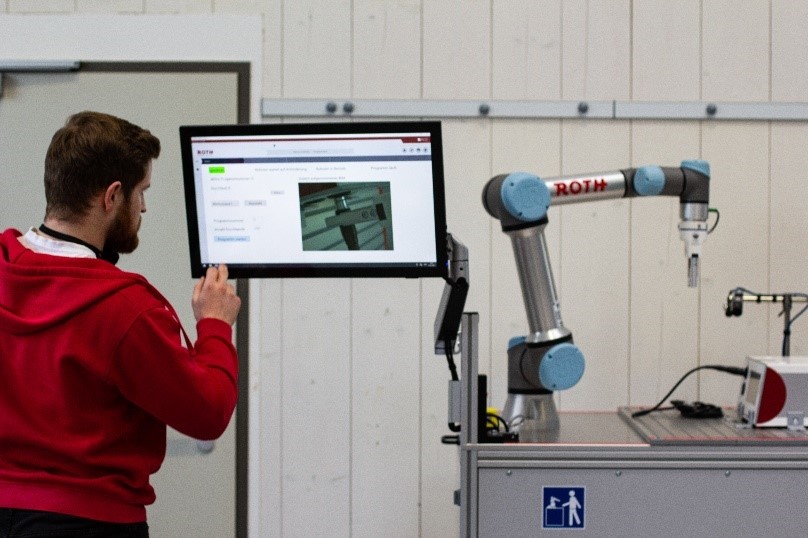
The MRK robot was mounted on a base frame with casters for mobile use. This base frame also serves as storage space for accessories. Thanks to the retractable supports, the robot system can be safely parked at a fixed location. Furthermore, the safety assessment was made possible by dividing the workspace into a “normal” area and a collaboration zone with the MRK robot, enabling efficient mixed-operation. This means there is an area where only the robot operates and an area where humans and robots work together. The integrated touchscreen user interface simplifies operation and visualization for the user. At the same time, reports are automatically generated for efficient evaluation.
- Control Technology
- MRK Robotics
- Commissioning of the Control Components
- Roth’s Own PC Solution – RPCS
- HMI Interface
- Camera Analysis
- Mechanical Design
- Support structure on casters, lowerable onto fixed supports
- Mechanical Assembly
- Hardware Design in E-Plan
- Electrical Installation
- Machine Safety Inspection
- Documentation
Successful Project Completion: A Positive Outcome
“From the very start of the project, Roth was a reliable and competent partner who supported us with advice and assistance. Their experience and expertise, along with their straightforward approach and constant openness to changing requirements throughout the development phase, contributed to the project’s success.”
(Customer)
